
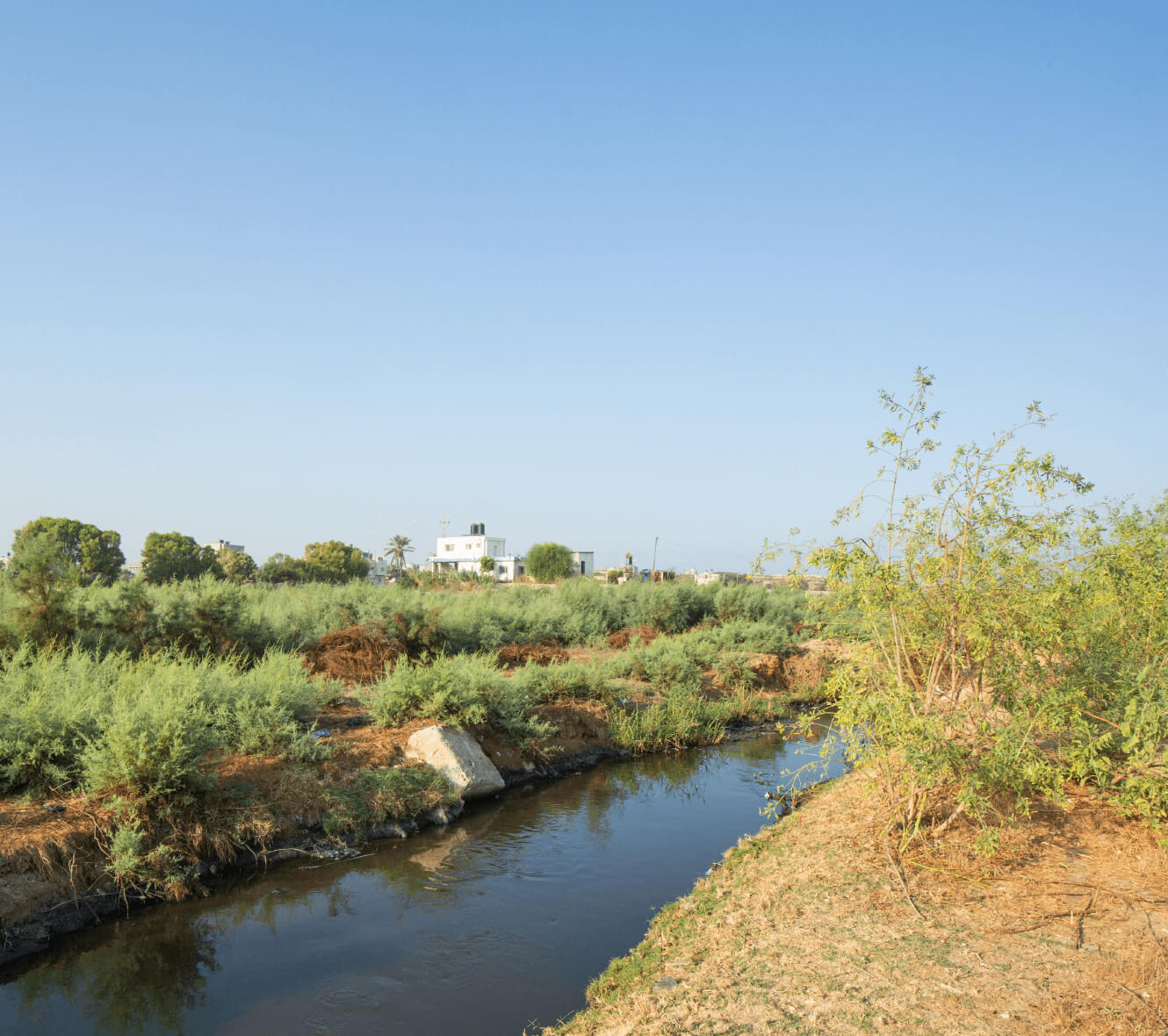
Climate Change and Extremes:
Reconstruction in Gaza must account for the region’s arid climate and ongoing environmental challenges, which will worsen living conditions and livelihood prospects. Addressing these issues is crucial for overcoming destruction, poverty, and distrust,
and for fostering a sustainable and resilient future. Climate change, particularly its effects on health through changing incidences of disease and exposure to debilitating and potentially fatal heat exposure, must be integrated into reconstruction processes. Socially, economically and physiologically vulnerable groups and individuals (the elderly, infants and under-fives, and those with cardio-vascular and other underlying health conditions) are most at risk. The One Health approach balancing the health of people, animals, and ecosystems, is
vital for this integration.
The Gaza Bioregion:
A bioregional approach to Gaza requires geographical and ecological analysis, incorporating
both experts and local inhabitants to redefine territorial boundaries collaboratively. A bioregion does not have distinct frontiers—these are blurred as neighbouring regions merge into each other, and indeed these areas of overlap are themselves of great interest. The term “Gaza Strip” has historically isolated Gaza, removing it from its natural territorial context. The geopolitical strife resulting from the Israeli-Palestinian conflict, alongside the legacy of the 1948 war and the creation of the “Otef” (a cordon of Israeli settlements along Gaza’s border), underscores the need for a new, inclusive narrative—one that fosters long-term coexistence through a shared cross-border bioregion. This vision would integrate Gaza with neighbouring territories in a larger bioregional context, where geographical and ecological links offer a pathway to peace and shared prosperity.
Health and Wellbeing:
Decisions made in the rebuilding process in every sector, from urban planning and housing to transportation and water sanitation, have essential impacts on human health. The “Health in All Policies” (HiAP) framework, adopted by the WHO, should guide decision-making across sectors to ensure that health, mental health and well-being are prioritized in all aspects of reconstruction.
Resources and References:
- Bamberger, Elazar. Hydrology - Strategic Plan for the Western Negev and the Tkuma Region (2024)
- Egypt, Ministry of Planning and Economic Development, 2030 Vision of Egypt: The National Agenda for Sustainable Development (2023)
- Israeli Planning Administration, Israel's Strategic Spatial Plan (2024)
- The Portland Trust, Gaza Spatial Vision Energy and Water (2016)
- The Portland Trust, Global Palestine Connected Gaza (2016)
- UNDP, Development of a Comprehensive Master Plan for the Wadi Gaza Area
- UNDP, Wadi Gaza Photo Album (2019)
- UNEP, Environmental Impact of the Conflict in Gaza (2024)
_Page_01.jpg)
A Vision of Hope
Anthedon is the collective work of a team from the HERITOPOLIS Consortium, together with other experts addressing specific issues relevant to the Initiative and in consultation with key local professionals.HERITOPOLIS - Heritage and the Metropolis - is an open-ended research network established in 2021 to explore how metropolises are being (re-)shaped by heritage and how they are redefining its meaning. HERITOPOLIS addresses these challenges linking research and practice through the UN-Habitat UNI – University Network Initiative – MetroHUB partnership and within the framework of the Sustainable Development Goals and the New Urban Agenda.The HERITOPOLIS Society is registered in Korea as an NGO #603-82-78661 and a member of the Korean Research Foundation, www.kci.go.kr #8B4813 www.heritopolis.org
The grant for the launching stage of the Anthedon Initiative was made possible thanks to the generous contribution of Fidelity Charitable.
Disclaimer
The Anthedon Initiative does not necessarily reflect the views of UNHABITAT and the MetroHUB